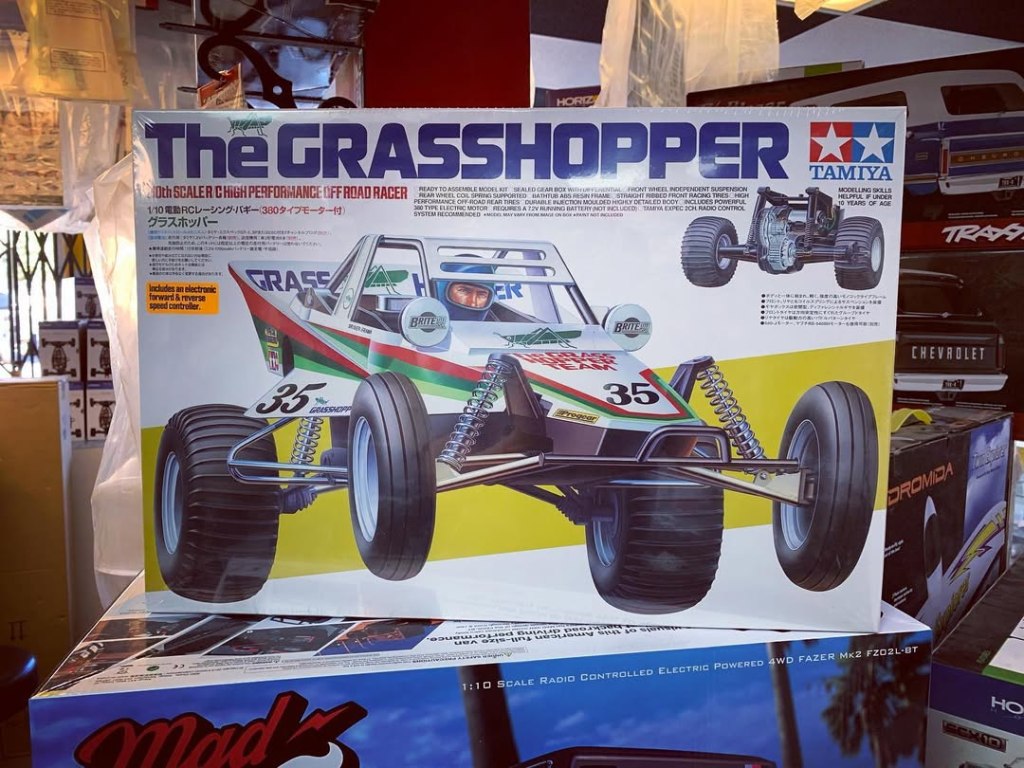
I’ve recently been on a Tamiya RC Car craze. I had a Grasshopper and Wild Willy 2 kit on the shelf and decided to build them. Long story short, I fell in love with how easy Tamiya kits were to build. I quickly ordered a TT-02 Porsche 911 RSR and M-05 Chassis kit on Ebay. That along with the TT-02RR and Subaru Brat I’ve already built last year, I figured I’d share what I found in common in most Tamiya RC Car kits.
Here are my 10 tips:
- You’re going to need a Phillips head screwdriver. Put away your fancy Protek hex driver set and dig into your home repair toolbox for a small screwdriver. All of the entry-level Tamiya RC kit comes with good ol’ Phillips head screws. You’re also going to need a hobby knife, tweezers and flush cutter. The tweezers will help you handle the delicate parts and the knife will help with applying decals. The flush cutter will help you trim the parts off the parts tree.
- You’re going to need to buy bearings. Unless you plan on putting the finished kit on a shelf as soon as you’re done, you will need to supply your own bearings. Entry-level Tamiya RC Car kits come with plastic “bearings” that shouldn’t be driven on. Don’t rush out and buy an $80 set of ceramic bearings, save those for the thousand dollar race cars. Easiest way to find a complete set of the bearings you will need is to search for them on Amazon or Ebay. Just type the chassis model of your car + bearings. (Example: TT-02 bearings, M-05 bearings, Grasshopper bearings, etc.) You will find several cunning entrepreneurs, such as FastEddy & DSM Offroad, who have made a living pre-packaging bearings sets conveniently for you to purchase. A complete set of rubber-sealed bearings typically cost around $15 USD.
- Most entry-level Tamiya RC Car kits comes with an Electronic Speed Control (ESC) and motor included. These electronics are surprisingly good for a brushed system setup and enough to get you started. The most common combination I have encountered is the TBLE-02S ESC with the Torque-Tuned motor. You may get a smaller 380 size motor in the classic re-releases such as the Grasshopper and Wild Willy 2. The TBLE-02S ESC is very versatile. It is a brushed ESC that is ready to pair with the included motor. When it’s time to upgrade to brushless, just connect to the third wire to a brushless motor and press the SET button. Note: If you don’t want to cut the ESC wires and solder your own connections to third-party brushless motors, consider using one of Tamiya’s selections with the bullet connector on all 3 wires.
- One draw-back of using the included TBLE-02S ESC is the battery connector. You won’t find too many Lipos that come with that style of plug. One option is to cut the ESC wires and solder on your choice of a Deans, XT60 or EC3 connectors. Another option is to use an adapter that has the Tamiya plug on one end and your choice of connector on the other. Just make sure you have the male / female selection right. Also watch out for battery compartments that only fit the batteries with round sides, known as “stick packs”. (Example: Wild Willy 2 and Subaru Brat) Then your choice of Lipo batteries are even fewer. One good Lipo option is the ProTek RC 2S 100C Si-Graphene + HV LiPo Stick Pack TCS Battery.
- However, the TBLE-02S ESC, it is not recommended for Lipo Batteries. The voltage cutoff is factory set too low to safely use Lipos. One workaround I employ but not recommended is to install a Lipo alarm. Use at your own risk or stick with the NiMh battery options.
- What is a TCS Battery you may ask? TCS stands for Tamiya Championship Series. It is Tamiya’s annual racing series exclusively dedicated to their own race car chassis. There is an extensive set of rules including which batteries are allowed. One of the races in the TCS was held at my local race track. Unfortunately it was cancelled earlier this year. But I look forward to participating in 2021. Perhaps there will be a separate future post about the topic.
- Keep track of the screws. Tamiya kits come with the screws and small parts in 3 or 4 separate bags. They are not separated into bags matching the manual build sequence. That means you have to be careful to match the length/type/color of the screw with the instructions. Fortunately the illustrations are printed very close to scale. So when I’m not sure, I hold the screw up to the paper to measure it.
- You can build the kit to suit your needs. If you get one of the on-road touring car chassis such as the TT-01, TT-02 or M Chassis, you may be able to choose your own wheelbase, ride height, wheel width to fit a body. For example, the TT-02 chassis can be built to the very common 257mm wheebase as well as a short 251mm instead. You can also build a road racer Impreza for the asphalt then flip the upgrights and put on bigger tires for a rally spec dirt track car. The M-05 Chassis even has 3 different wheelbase lengths to accommodate different body shells.
- Tamiya entry-level kits are not known for its precise tolerances. I’ve never had any parts fitment issues but there’s always a little slop in the arms and joints. If you plan on building a kit for the track or club racing, I suggest shimming the slop out of the arms, diffs and axles. This will give you more concise and consistent handling and power throughout your run.
- Don’t trim the body posts too short. When you’re done painting and building the body, the temptation is to pin it as close to the chassis as possible. For each post, use a lower pin to set the body position and place the upper pin 2 to 3 holes above the body. This will allow the body to flex as you’re traversing the road. A tightly pinned body will cause the car to bounce.
Thanks for reading my first article. I hope you found it helpful. If you enjoyed it and look forward to other RC and Tamiya related content, please check out my Instagram and Youtube Channel. On the sound of the tone…


 RC's RC Cars
Leave a comment